


By: Aaron Patton and Naba Amgain, Purdue University
Why We Did This Research
Golf course superintendents routinely apply the plant growth regulator (PGR) trinexapac-ethyl (Primo® Maxx) to suppress vertical shoot growth, improve playing surface quality, and reduce mowing frequency on putting greens. It is equally common practice to tank-mix Primo Maxx with micronutrient products containing iron (Fe), manganese (Mn), or zinc (Zn), or to use spray water that is naturally high in calcium (Ca) and magnesium (Mg)—what is commonly called “hard water.” These elements are divalent cations, and research in weed science has clearly shown that divalent cations can reduce the efficacy of certain herbicides by forming chemical complexes that limit absorption and translocation. Because Primo Maxx shares some chemical characteristics with those sensitive herbicides, concern arose that similar antagonism could occur with PGR applications. Earlier work in perennial ryegrass suggested this might be possible. Yet no research had directly examined this question under putting green management—until now.
What We Did
Researchers at Purdue University conducted a two-year greenhouse study using TifEagle™ hybrid bermudagrass maintained at putting green height (0.2 inches). We tested this on bermudagrass because this work was part of a collaborative project with the University of Arkansas and the University of Tennessee looking at managing shaded warm-season putting greens. Primo® Maxx was applied at 3 fl oz/A—the labeled rate for ultradwarf bermudagrass—either alone in distilled water or tank-mixed with Ca, Mg, Fe, Mn, or Zn. Cation concentrations were set to achieve very hard water conditions. Vertical growth was tracked three times per week over the 42-day study period, and clipping yield was measured at the end of the trial. The experiment was repeated in a second year to confirm the results.
What We Found
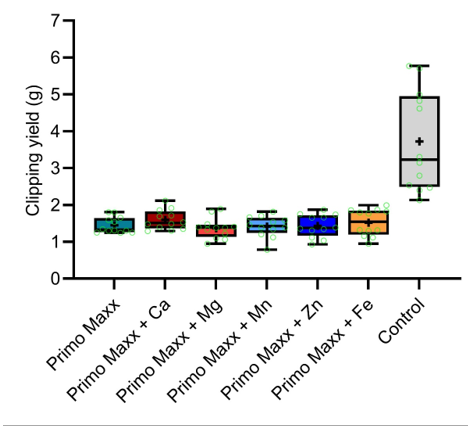
The results were consistent and clear across both years: Primo® Maxx effectively suppressed bermudagrass growth regardless of which divalent cation was present in the spray solution (see Figure). Compared to the untreated control, all Primo Maxx treatments—whether applied in distilled water or tank-mixed with Ca, Mg, Fe, Mn, or Zn—achieved 57 to 63% suppression in clipping yield over the 42-day period. No antagonism was detected, and no phytotoxicity was observed under any treatment. Spray solution pH ranged widely (3.5 to 9.3 depending on the cation source), and water hardness ranged from 0 to 35 grains/gallon, yet PGR performance was unaffected across this entire range.
Why no antagonism? The likely explanation lies in the chemistry of the formulation. Primo Maxx is formulated as an ester (trinexapac-ethyl), and ester-formulated products are generally not susceptible to the same cation-based antagonism seen with herbicides formulated as weak acids.
Practical Recommendations for Superintendents
Based on this research, golf course superintendents managing putting greens can confidently:
- Tank-mix Primo® Maxx with iron, manganese, or zinc micronutrient products without concern that the PGR’s efficacy will be reduced.
- Apply Primo® Maxx using well water or other naturally hard water sources without expecting a reduction in growth suppression.
It is worth noting that this study was conducted on a single hybrid bermudagrass cultivar following a single application. Results under different turfgrass species, management intensities, or repeated-application programs may differ. Additionally, water quality factors beyond those evaluated here could potentially influence trinexapac-ethyl behavior and warrant further investigation.
This newsletter article is a condensed version of a peer-reviewed research paper. For full methods, data, and discussion, please refer to the original publication:
Amgain, N.R., M.D. Richardson, J.T. Brosnan, and A.J. Patton. 2026. Water quality effects on trinexapac-ethyl performance in hybrid bermudagrass. Crop, Forage, and Turfgrass Mgmt. In press.